The Cognitive Science Program is excited to announce that it will be continuing the Cognitive Science Travel Award Program for another year!
The Cognitive Science Program’s mission is to prepare students to tackle global and multicultural challenges. Experiences abroad are vital to this preparation. Yet students majoring in Cognitive Science and related-STEM fields are generally less likely to participate in study abroad programs than other students.
These awards are available to UConn undergraduate students majoring or minoring in Cognitive Science or, students strongly considering the major/minor in the future. Priority will be given to students attending the Interdisciplinary Ethnography Field Summer School in Mauritius, the Neuroscience Study Abroad Summer Program in Salamanca, Spain, and UConn Brain & Behavior in Tel Aviv, Israel. All program details can be found on the Experiential Global Learning webpage. Courses taken through these summer programs can be counted as elective credits towards the Cognitive Science degree. This program will also support students traveling domestically or internationally to conferences, workshops, and meetings. Students planning to travel internationally will be eligible to apply for up to $2,000 and $1,000 for domestic travel. Any travel costs in excess of the allotment would be the responsibility of the recipient. The Cognitive Science Program is willing to review other international and domestic travel scenarios on a case-by-case basis.

Deadline: This award program operates with a rolling deadline. Once funds are exhausted, the application will close. While students can apply at any time, travel awards will be contingent on (a) applying and being accepted into a study abroad program and (b) sharing an official acceptance notification with us.
Priority consideration will be given to students who (1) are members of a group that is underrepresented at the University of Connecticut; or (2) have overcome obstacles such as socioeconomic, educational, or other societal disadvantages (arising, for example, through prejudice and/or discrimination); or (3) have worked with such groups to help overcome these or other obstacles.
Questions regarding the Cognitive Science Study Abroad Travel Award Program may be sent to cogsci@uconn.edu.
Please visit the Study Abroad Travel webpage for more information, including eligibility requirements and how to apply.
Research Coordinator, Connecticut Project
The TMW Center for Early Learning + Public Health (TMW Center) develops science-based interventions, tools, and technologies to help parents and caregivers interact with young children in ways that maximize brain development. A rich language environment is critical to healthy brain development, however few tools exist to measure the quality or quantity of these environments. Access to this type of data allows caregivers to enhance interactions in real-time and gives policy-makers insight in how to best build policies that have a population-level impact.
Job Summary
The Research Coordinator will report to the Senior Project Manager and shall provide on-the-ground coordination, implementation, and research support. The Research Coordinator will work closely with Connecticut-based infant and toddler childcare providers and TMW Center research and curriculum staff. The Research Coordinator shall be responsible for recruiting and consenting study participants, providing regular implementation and technical support to study participants, data collection, and operational and logistical coordination of various study activities.
As a primary on-the-ground point of contact for study participants, the Research Coordinator shall build positive relationships with childcare centers, classroom teachers, families and OEC staff to ensure strong communication and a successful research partnership with the TMW Center.
Responsibilities
Participant Outreach, Recruitment & Data Collection:
Implementation & Participant Support:
Research Support:
Partnership Building:
Project Support:
Other Responsibilities:
Sentence and Discourse Processing (PSYC 5583)
Fall, 2023 (timeslot to be determined)
Instructor: Whitney Tabor (whitney.tabor@uconn.edu)
This course provides an introduction to psycho- and computational linguistics at the sentence and discourse levels. It includes a theoretically-grounded exploration of Deep Learning/Large Language Models (LLMs), linking these to psycholinguistic work on phenomena at the boundary of competence and performance. The course focuses on a number of structural/semantic phenomena of interest, selected from case-marking, agreement, long-distance dependencies, recursion, event-structure, and semantic/pragmatic factors in islandhood among others. It considers cases where some researchers have argued that competence and performance phenomena are linked, and it asks what implications these phenomena have for the theory of language.
The course will be offered in Fall, 2023. It is currently listed in the time schedule as occurring on Mondays from 1:30-4:30 but this timeframe will almost certainly change once it becomes clear who plans to take the course. If you are interested, please send email to whitney.tabor@uconn.edu.
We are asking you to save the date for the 2023 IBACS Meet & Speak event on Friday, April 28th from 9-4:30pm. This exciting event will be in-person in Konover Auditorium.
Affiliated faculty will give 10-minute talks, most of which are on the research they have carried out, or propose carrying out, with seed funding awarded by IBACS. Affiliated graduate students who have received IBACS funding will present 5-minute “datablitz” style talks.
The event will provide an opportunity to learn more about the diverse interdisciplinary research of IBACS affiliates, provide a forum for cross-disciplinary networking, and will introduce our refurbished EEG Lab and our new UConn Science Alliance Mobile (SAM)!
Schedule
9:15AM – Welcome
9:30AM – Panel Discussion
10:15AM – Faculty Talks
11:25AM – Graduate Student Data Blitz
12:00PM – Lunch
1:00PM – Keynote Speaker: Dr. Diego Bohorquez, Duke University
2:30PM to 4:30PM – Tours of the UConn Science Alliance Mobile (UConn SAM) and EEG Lab
A more detailed program including speaker names, talk titles, and the focus of the panel discussion will be shared soon.
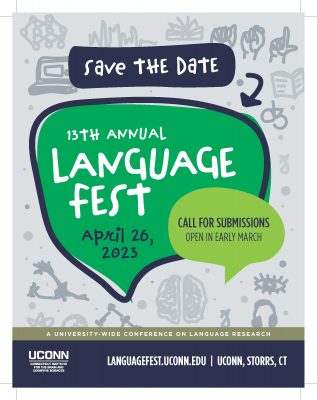
We are excited to announce that Language Fest is making an in-person return for 2023, and invite you to join us on the afternoon of Wednesday, April 26th (event times TBD).
Language Fest is a University-wide research conference that welcomes the full cross-disciplinary community of language researchers at UConn for a day of sharing results, ideas, methodologies, and fostering future interdisciplinary collaborations. Researchers from all disciplines of the language sciences and at all career stages are welcome and encouraged to submit their work.
Further details about submissions and registration will be provided in early-March 2023.
For any questions about Language Fest, please e-mail: langfest@uconn.edu and visit our website https://languagefest.uconn.edu/.
We look forward to your attendance and participation!

The Cognitive Science Program invites you to a talk on 2/24!

Speaker: Dr. Thomas Naselaris, an Associate Professor from Department of Neuroscience at the University of Minnesota.
Time & Location: 4PM, Friday February 24th, 2023, in Oak Hall Room 117. Light refreshments will be provided.
RSVP Form
Talk Title: “Why Do We Have Mental Images?”
Abstract: Everyone who experiences mental imagery is the world expert on the contents of their own mental images. We argue that this privileged perspective on one’s own mental images provides very limited understanding about the function of mental imagery, which can only be understood by proposing and testing hypotheses about the computational work that mental images do. We propose that mental imagery functions as a useful form of inference that is conditioned on visual beliefs. We implement this form of inference in a simple generative model of natural scenes, and show that it makes testable predictions about differences in tuning to seen and imagined features. We confirm these predictions with a large-scale fMRI experiment in which human brain activity was sampled while subjects generated hundreds of mental images. We speculate that ongoing mental imagery may impact the structure of noise correlations in the visual system, and present a preliminary analysis of the Natural Scenes Dataset that appears to be consistent with these speculations.
Bio: Thomas is an Associate Professor in the Department of Neuroscience at the University of Minnesota, and a member of the Medical Discovery Team on Optical Imaging and Brain Science at the Center for Magnetic Resonance Research. He is co-founder and currently Executive Chair of the Conference on Cognitive Computational Neuroscience.
“’Small wins’ feature in a big way in Davenport’s first venture and in StarMind’s initial product, The Guide – an interactive journal that combines daily logs, “morning mindfulness” activities, and areas for reflection with key psychology concepts and curated online content accessible through QR codes imbedded into an American-made navy leather-bound tome.”
View the article Here
“’I think a lot of students are worried about whether it’s too late or too early to get involved,’ she says. ‘I think that people shouldn’t be afraid to dive in if they’re really interested, because we’re a research university, and UConn has a lot of opportunities if you’re willing to seek them out.'”
“A proud Husky alumna, Kaufman works as an investigative researcher with the Anti-Defamation League’s Center on Extremism. A leading authority on hate, extremism, antisemitism and terrorism, the center’s researchers, including Kaufman, monitor the online presence of groups and organizations in order to expose and disrupt them, to educate law enforcement about the workings and actions of the groups, and to help the public identify and deal with extremist threats.”
The Extremist Watchdog: Meet the Husky Who Tracks Online Hate